> ## Documentation Index
> Fetch the complete documentation index at: https://docs.libratech.ai/llms.txt
> Use this file to discover all available pages before exploring further.
# The Editor
> Find your way around the Editor, format the document, let Libra work on it in the Editor chat, and save, publish and restore versions.
The Editor shows your document as pages, just like Word, with the toolbar above and the Editor chat beside it. Whatever you change is saved to the document itself, with a version history behind it.
## Find your way around
The Editor has five areas.
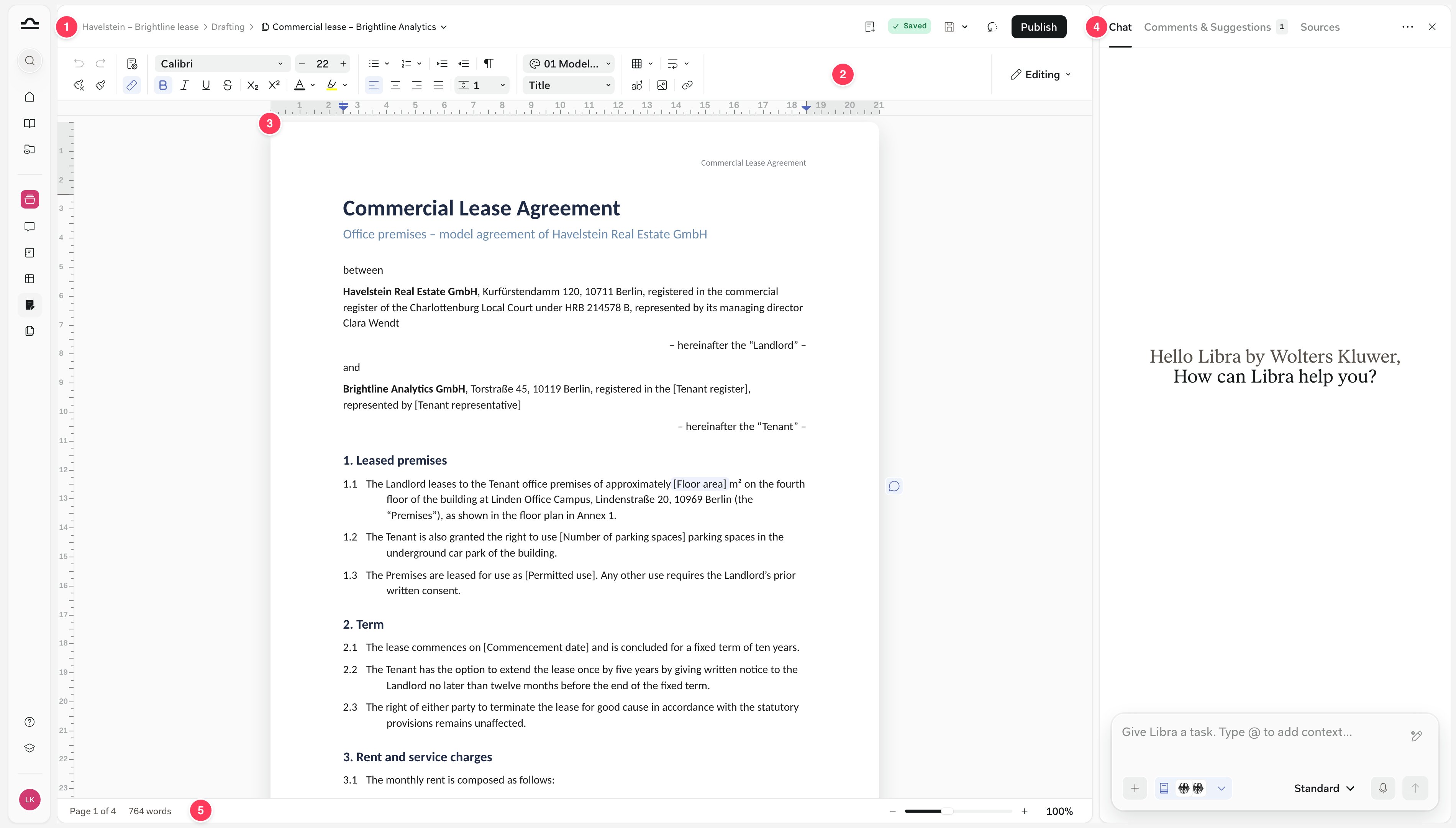 1. **Title bar**: the project › **Drafting** › the document's name. **Drafting** takes you back to the Drafting page, and the name opens the [document menu](#download-and-print). On the right: the save status, **Save**, **History** and **Publish**.
2. **Toolbar**: formatting in two rows, ending in the **Editing** / **Suggesting** switch explained in [Collaboration](/en/features/drafting/collaboration#editing-or-suggesting).
3. **Page**: your document, laid out as pages, with comments and suggestions in the margin on the right.
4. **Right panel**: three tabs, **Chat**, **Comments & Suggestions** and **Sources**. **Page setup** and **History** open here too, and **✕** closes it. The chat bubble at the bottom right brings it back.
5. **Bottom bar**: the page you're on, the word count (or the count for your selection) and zoom.
## Format the document
The toolbar works the way you know from Word. Settings for the whole document, such as margins and columns, live in the **Formatting** panel.
### Text and paragraphs
The toolbar groups its controls from left to right. In a narrow window the groups fold into menus one at a time, from the right, but nothing disappears.
1. **Title bar**: the project › **Drafting** › the document's name. **Drafting** takes you back to the Drafting page, and the name opens the [document menu](#download-and-print). On the right: the save status, **Save**, **History** and **Publish**.
2. **Toolbar**: formatting in two rows, ending in the **Editing** / **Suggesting** switch explained in [Collaboration](/en/features/drafting/collaboration#editing-or-suggesting).
3. **Page**: your document, laid out as pages, with comments and suggestions in the margin on the right.
4. **Right panel**: three tabs, **Chat**, **Comments & Suggestions** and **Sources**. **Page setup** and **History** open here too, and **✕** closes it. The chat bubble at the bottom right brings it back.
5. **Bottom bar**: the page you're on, the word count (or the count for your selection) and zoom.
## Format the document
The toolbar works the way you know from Word. Settings for the whole document, such as margins and columns, live in the **Formatting** panel.
### Text and paragraphs
The toolbar groups its controls from left to right. In a narrow window the groups fold into menus one at a time, from the right, but nothing disappears.
 1. Undo and redo, **Clear formatting** and **Format painter**.
2. **Settings**: **Page setup**, which opens the Formatting panel, and **Ruler**.
3. **Text**: font, size, bold, italic, underline, strikethrough, subscript, superscript, text colour and highlight.
4. **Paragraph**: bulleted and numbered lists, indents, **Show marks**, alignment and line spacing.
5. **Styles**: **Theme** and the paragraph style.
6. **Insert**: table, break, footnote, image and link.
**Format painter** copies formatting, as in Word. Put the caret in the text whose look you want, click the brush, then click a word or drag across text to paint it.
Double-click the brush to paint several places; Esc stops it. **Clear formatting** works the same way and resets text to the document's default style.
### Text styles
The paragraph style menu works like Word's style gallery. Each style shows in its own look, and the one you're in has a tick.
1. Undo and redo, **Clear formatting** and **Format painter**.
2. **Settings**: **Page setup**, which opens the Formatting panel, and **Ruler**.
3. **Text**: font, size, bold, italic, underline, strikethrough, subscript, superscript, text colour and highlight.
4. **Paragraph**: bulleted and numbered lists, indents, **Show marks**, alignment and line spacing.
5. **Styles**: **Theme** and the paragraph style.
6. **Insert**: table, break, footnote, image and link.
**Format painter** copies formatting, as in Word. Put the caret in the text whose look you want, click the brush, then click a word or drag across text to paint it.
Double-click the brush to paint several places; Esc stops it. **Clear formatting** works the same way and resets text to the document's default style.
### Text styles
The paragraph style menu works like Word's style gallery. Each style shows in its own look, and the one you're in has a tick.
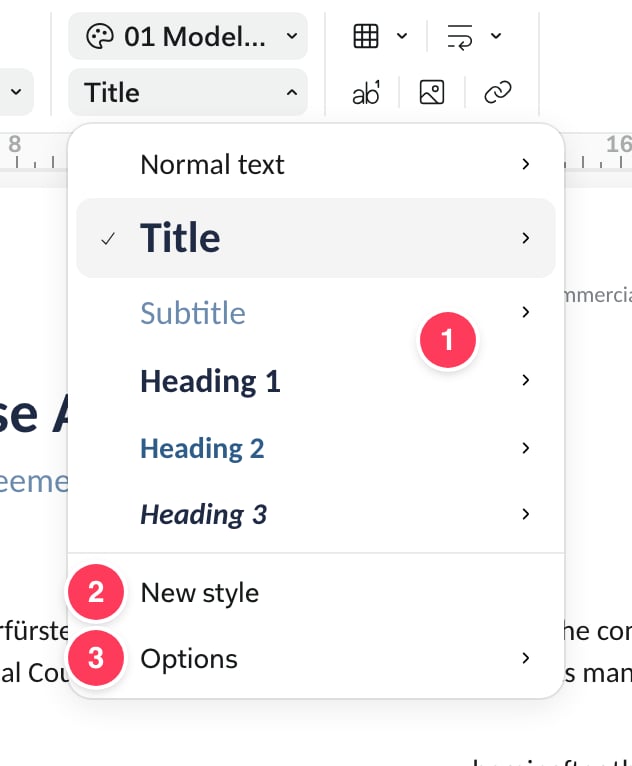 1. The styles. The arrow next to each offers **Apply** with its shortcut, such as ⌘⌥2 for Heading 2, **Update … to match**, which redefines the style from the paragraph you're in, and **Rename**.
2. **New style** adds one of your own.
3. **Options**: **Save as my default styles**, **Use my default styles** and **Reset styles**.
If the Word file brought its own styles, they're listed under **Document styles**. To delete a style or add it to your theme, see [Apply and change a theme](/en/features/drafting/templates#apply-and-change-a-theme).
### Lists and legal numbering
Numbered lists come with presets for legal documents. Open the arrow next to **Numbered list**, choose the jurisdiction at the top, then a preset.
1. The styles. The arrow next to each offers **Apply** with its shortcut, such as ⌘⌥2 for Heading 2, **Update … to match**, which redefines the style from the paragraph you're in, and **Rename**.
2. **New style** adds one of your own.
3. **Options**: **Save as my default styles**, **Use my default styles** and **Reset styles**.
If the Word file brought its own styles, they're listed under **Document styles**. To delete a style or add it to your theme, see [Apply and change a theme](/en/features/drafting/templates#apply-and-change-a-theme).
### Lists and legal numbering
Numbered lists come with presets for legal documents. Open the arrow next to **Numbered list**, choose the jurisdiction at the top, then a preset.
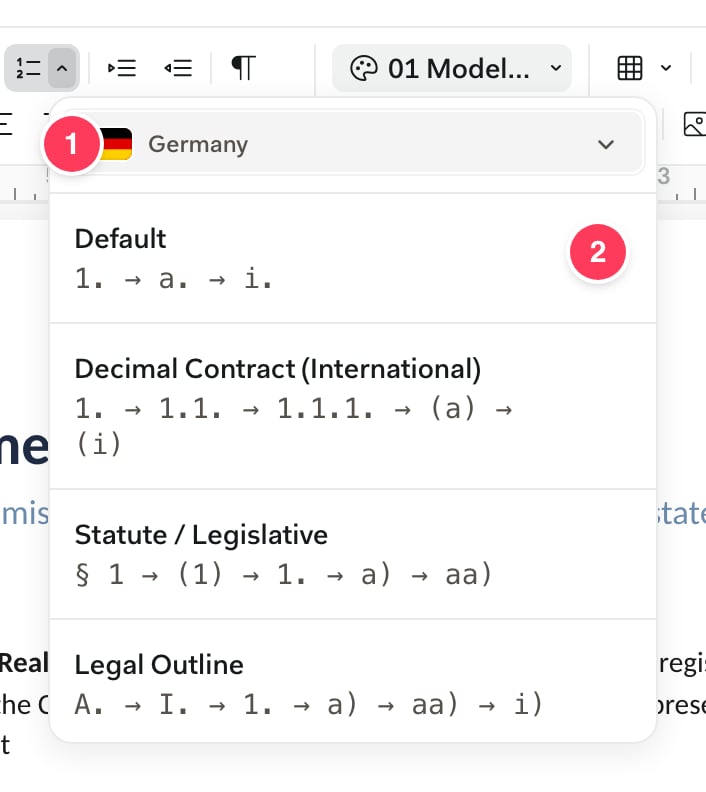 1. The jurisdiction: Germany, Switzerland, Poland, the Netherlands, Belgium, Italy, Hungary, Romania, the Czech Republic, Slovakia or the European Union.
2. The presets for that jurisdiction, each with its pattern. **Decimal Contract (International)** runs 1. → 1.1. → 1.1.1. → (a) → (i), and the German **Statute / Legislative** runs § 1 → (1) → 1. → a) → aa).
The numbering is real list numbering, not typed characters. Insert a clause above 4.2 and it becomes 4.3 by itself.
### Page setup
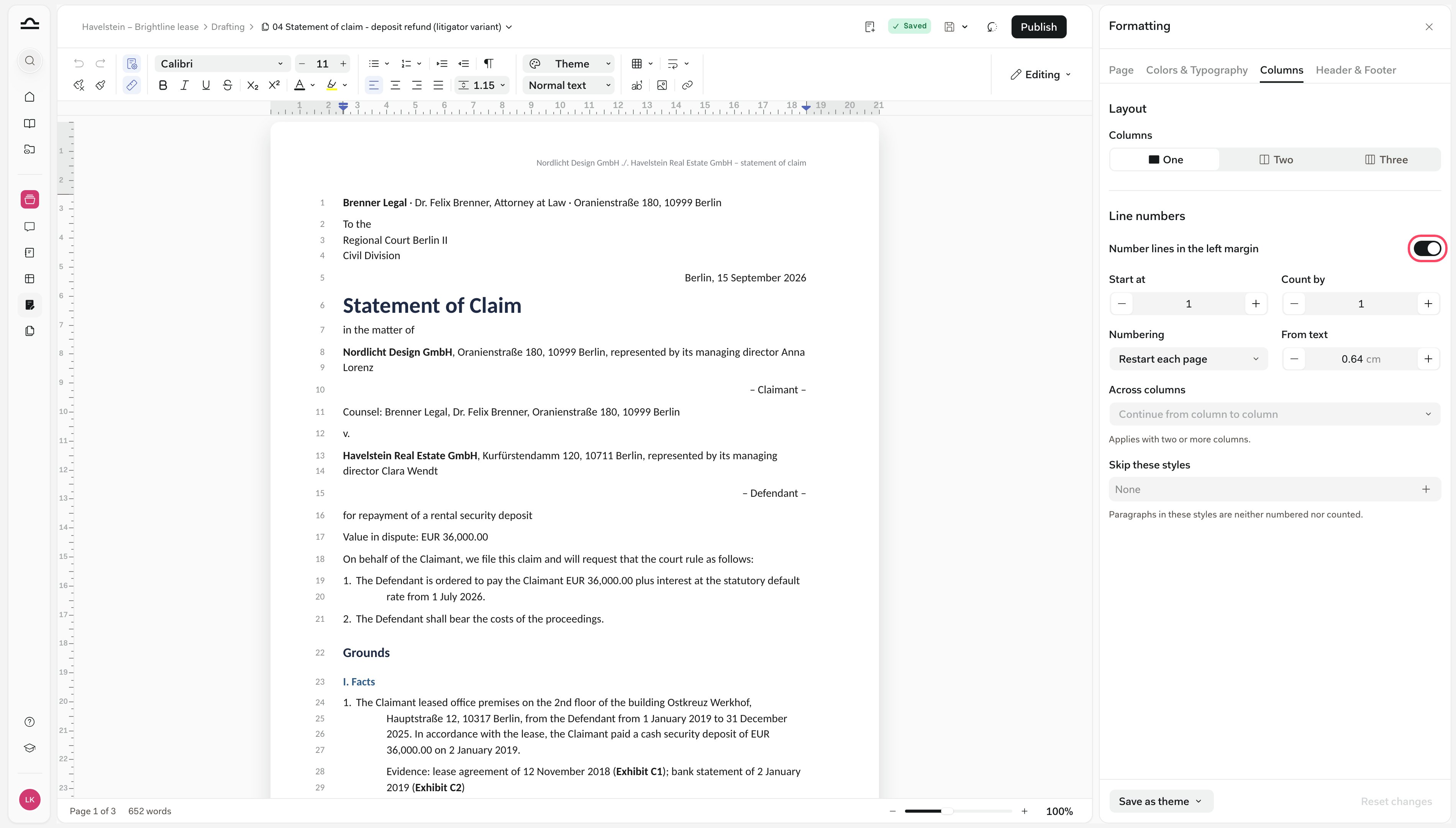
**Page setup** in the toolbar opens the **Formatting** panel on the right. Changes apply to the whole document straight away.
1. The jurisdiction: Germany, Switzerland, Poland, the Netherlands, Belgium, Italy, Hungary, Romania, the Czech Republic, Slovakia or the European Union.
2. The presets for that jurisdiction, each with its pattern. **Decimal Contract (International)** runs 1. → 1.1. → 1.1.1. → (a) → (i), and the German **Statute / Legislative** runs § 1 → (1) → 1. → a) → aa).
The numbering is real list numbering, not typed characters. Insert a clause above 4.2 and it becomes 4.3 by itself.
### Page setup
**Page setup** in the toolbar opens the **Formatting** panel on the right. Changes apply to the whole document straight away.
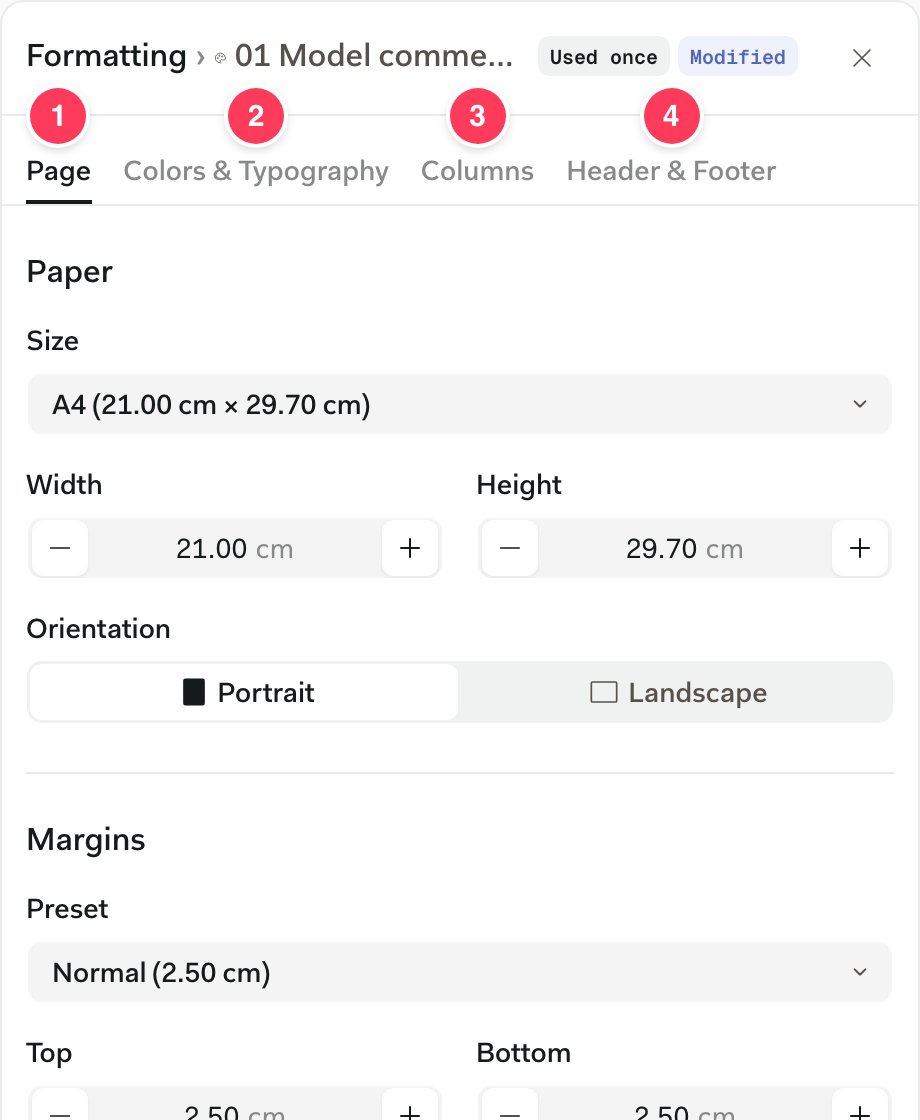 1. **Page**: paper size and orientation, margins with presets such as **DIN 5008 letterhead**, a binding gutter, and mirrored margins for double-sided printing.
2. **Colors & Typography**: the theme's colours and text styles. See [Apply and change a theme](/en/features/drafting/templates#apply-and-change-a-theme).
3. **Columns**: one, two or three columns with spacing and a divider, and **Line numbers** for briefs.
4. **Header & Footer**: header and footer distance, a different first page or odd and even pages, and page numbers.
Undo (⌘Z) doesn't reverse page setup, but **Reset changes** at the bottom of the panel does. **Save as theme**, next to it, turns your settings into a [theme](/en/features/drafting/templates#create-a-theme-in-the-editor).
Line numbers can restart on each page and skip styles such as headings.
1. **Page**: paper size and orientation, margins with presets such as **DIN 5008 letterhead**, a binding gutter, and mirrored margins for double-sided printing.
2. **Colors & Typography**: the theme's colours and text styles. See [Apply and change a theme](/en/features/drafting/templates#apply-and-change-a-theme).
3. **Columns**: one, two or three columns with spacing and a divider, and **Line numbers** for briefs.
4. **Header & Footer**: header and footer distance, a different first page or odd and even pages, and page numbers.
Undo (⌘Z) doesn't reverse page setup, but **Reset changes** at the bottom of the panel does. **Save as theme**, next to it, turns your settings into a [theme](/en/features/drafting/templates#create-a-theme-in-the-editor).
Line numbers can restart on each page and skip styles such as headings.
 A Word file with several sections keeps them, each with its own headers and footers. Saving changes only what you edited, so Word's compare shows your edits and nothing else.
### Tables, images, footnotes and breaks
**Insert**, at the right end of the toolbar, adds a table, a break, a footnote, an image or a link. Click inside a table and its own toolbar appears above it.
A Word file with several sections keeps them, each with its own headers and footers. Saving changes only what you edited, so Word's compare shows your edits and nothing else.
### Tables, images, footnotes and breaks
**Insert**, at the right end of the toolbar, adds a table, a break, a footnote, an image or a link. Click inside a table and its own toolbar appears above it.
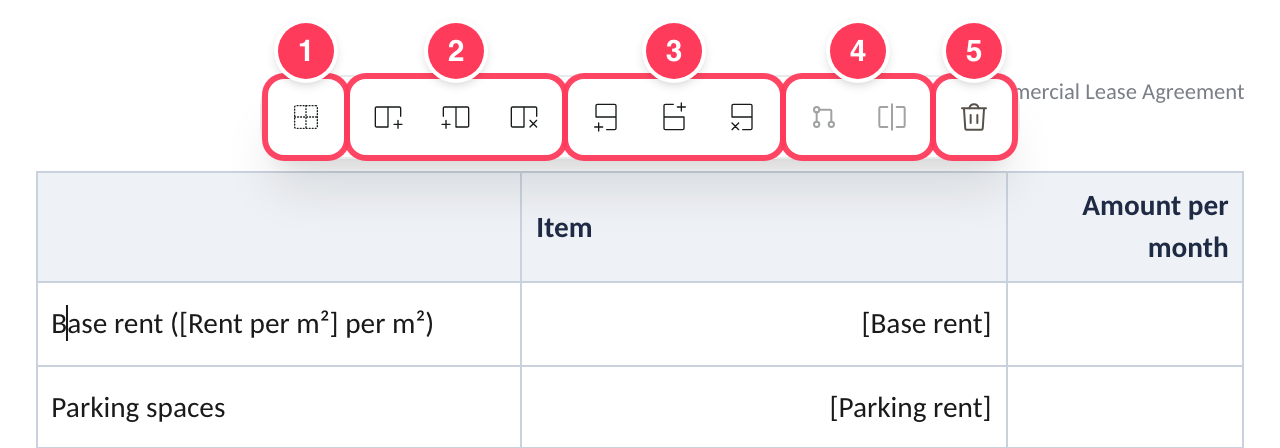 1. **Hide table borders**, which keeps the grid invisible in Word too.
2. Insert a column to the left or right, or delete one.
3. Insert a row above or below, or delete one.
4. **Merge cells** and **Split cell**.
5. **Delete table**.
* **Images**: PNG, JPEG, SVG and other common formats, up to 20 MB. Click an image to resize it or change its **Text wrapping**.
* **Footnotes**: **Insert footnote** adds a numbered footnote at the bottom of the page and renumbers the rest. Footnotes with tables, lists or tracked changes open read-only.
* **Breaks**: a line break (Shift+Enter), a page break (Ctrl+Enter), or a column break (Ctrl+Shift+Enter) in a multi-column layout.
## Work with Libra in the Editor chat
The **Chat** tab is the same chat you use everywhere in Libra, with its [tools](/en/features/chat/tools), [research](/en/features/chat/research-mode) and Assistants. The difference: it works on the document you have open, including edits you haven't saved, and changes it in place instead of writing a new file.
It can still write new files: **Draft document** and **Build spreadsheet** in **Tools** create a Word document or an Excel sheet from the one you have open.
### Scoped changes
Select a passage before you ask, and Libra changes that passage only. The chat box shows a **Selected Text** chip with the word count, and Libra still reads the whole document for context.
This is a *scoped change*. With clause 7.1 on minor repairs selected, *"Make this more favourable to the tenant."* rewrites 7.1 and nothing else. To drop the selection, clear the chip with **×**.
In **Editing** mode, Libra's changes go straight into the document, and the chat reports them on a card such as *Libra changed 1 passage*. **Show changes** steps through them on the page, with **Revert** and **Revert all** in the bar at the bottom.
The card's undo icon, **Revert changes**, takes back everything from that answer. Before Libra's first change in a session, the Editor also saves a **Before Libra’s changes** version to [Version history](#version-history).
### Research in the Editor
Switch on research sources in the chat box, as in any [research chat](/en/features/chat/research-mode), and ask about the clause you've selected. Libra answers in the chat, with citations to the sources it used.
1. **Hide table borders**, which keeps the grid invisible in Word too.
2. Insert a column to the left or right, or delete one.
3. Insert a row above or below, or delete one.
4. **Merge cells** and **Split cell**.
5. **Delete table**.
* **Images**: PNG, JPEG, SVG and other common formats, up to 20 MB. Click an image to resize it or change its **Text wrapping**.
* **Footnotes**: **Insert footnote** adds a numbered footnote at the bottom of the page and renumbers the rest. Footnotes with tables, lists or tracked changes open read-only.
* **Breaks**: a line break (Shift+Enter), a page break (Ctrl+Enter), or a column break (Ctrl+Shift+Enter) in a multi-column layout.
## Work with Libra in the Editor chat
The **Chat** tab is the same chat you use everywhere in Libra, with its [tools](/en/features/chat/tools), [research](/en/features/chat/research-mode) and Assistants. The difference: it works on the document you have open, including edits you haven't saved, and changes it in place instead of writing a new file.
It can still write new files: **Draft document** and **Build spreadsheet** in **Tools** create a Word document or an Excel sheet from the one you have open.
### Scoped changes
Select a passage before you ask, and Libra changes that passage only. The chat box shows a **Selected Text** chip with the word count, and Libra still reads the whole document for context.
This is a *scoped change*. With clause 7.1 on minor repairs selected, *"Make this more favourable to the tenant."* rewrites 7.1 and nothing else. To drop the selection, clear the chip with **×**.
In **Editing** mode, Libra's changes go straight into the document, and the chat reports them on a card such as *Libra changed 1 passage*. **Show changes** steps through them on the page, with **Revert** and **Revert all** in the bar at the bottom.
The card's undo icon, **Revert changes**, takes back everything from that answer. Before Libra's first change in a session, the Editor also saves a **Before Libra’s changes** version to [Version history](#version-history).
### Research in the Editor
Switch on research sources in the chat box, as in any [research chat](/en/features/chat/research-mode), and ask about the clause you've selected. Libra answers in the chat, with citations to the sources it used.
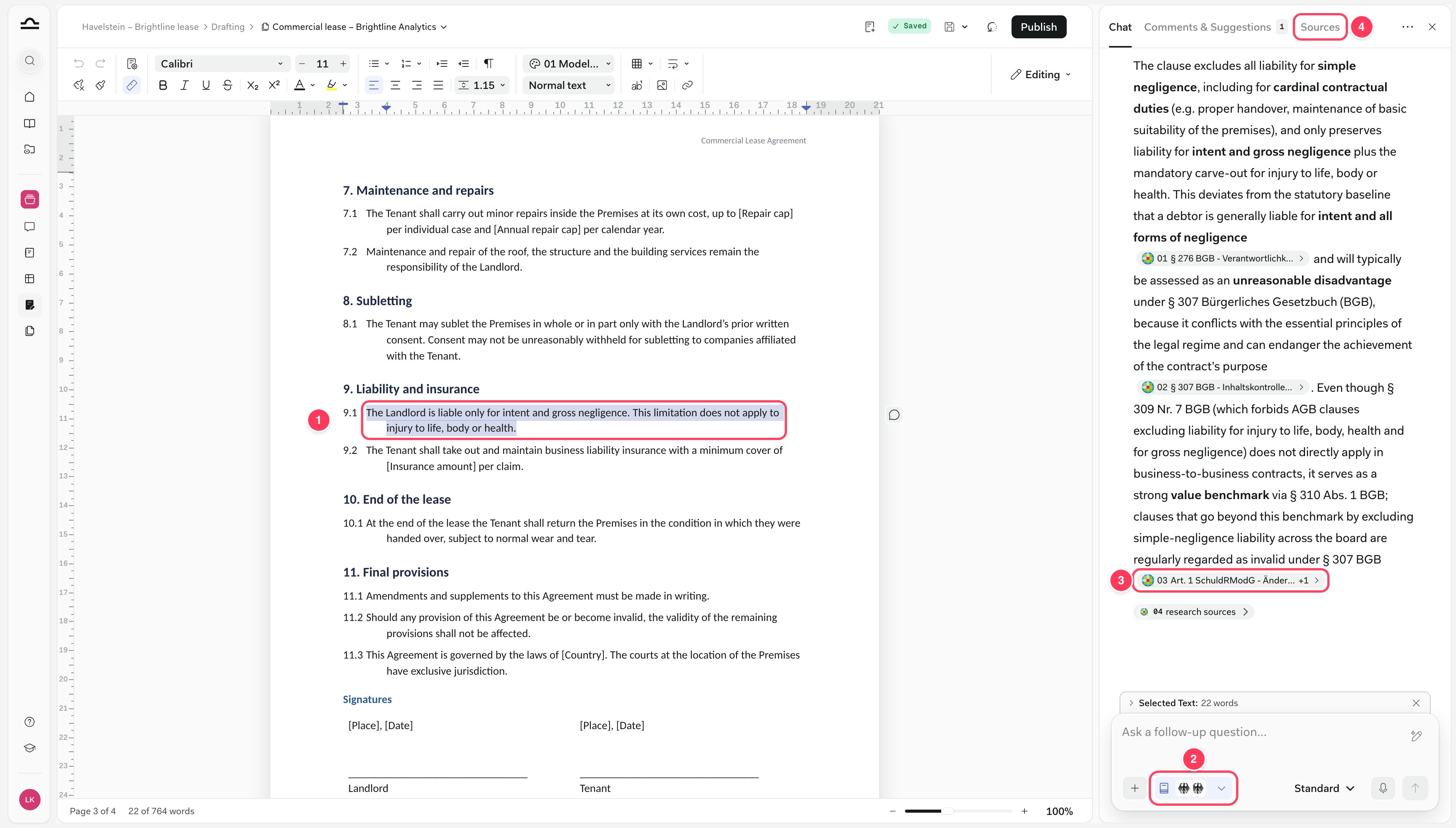 1. The selected clause, here 9.1 on the landlord's liability
2. The research sources switched on in the chat box, here German Statutes and German Case Law
3. A citation to one of those sources
4. The **Sources** tab
The **Sources** tab lists the sources behind Libra's latest answer. The chip under an answer, such as **04 research sources**, opens the list for that answer.
1. The selected clause, here 9.1 on the landlord's liability
2. The research sources switched on in the chat box, here German Statutes and German Case Law
3. A citation to one of those sources
4. The **Sources** tab
The **Sources** tab lists the sources behind Libra's latest answer. The chip under an answer, such as **04 research sources**, opens the list for that answer.
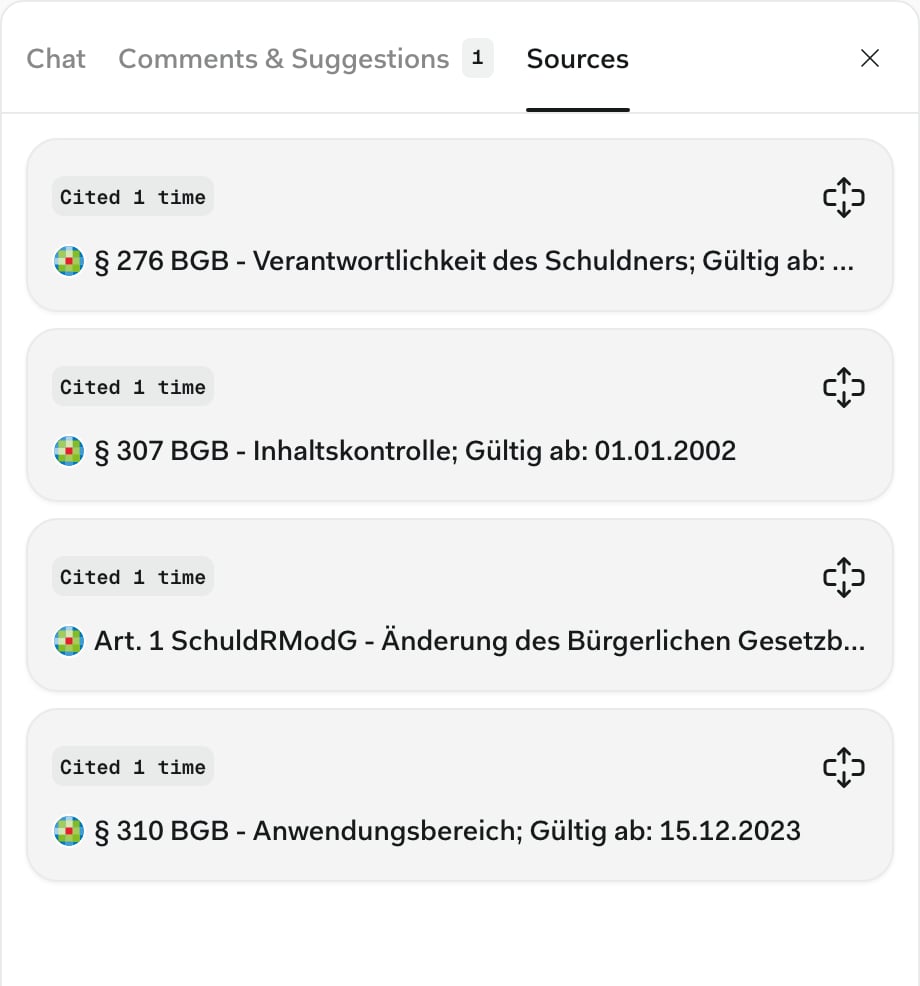 To act on an answer, keep the clause selected and ask for the change: *"Rewrite this clause so it holds up under § 307 BGB."*
### Your document chats
Each document keeps its own chat history, separately for each user, and your chats stay private when you share the draft.
The **⋯** menu at the right end of the tab row has **Chat History**, to search earlier conversations, **New Chat**, for a fresh one about the same document, and **Show fullscreen**, which continues the conversation in the main chat.
## Save, publish and restore
Saving keeps your work. Publishing decides what everyone else sees.
### Save
The Editor saves automatically 30 seconds after your last edit. **Save** in the title bar (⌘S) saves straight away as a named version, and comments and suggestions save the moment you add them.
To act on an answer, keep the clause selected and ask for the change: *"Rewrite this clause so it holds up under § 307 BGB."*
### Your document chats
Each document keeps its own chat history, separately for each user, and your chats stay private when you share the draft.
The **⋯** menu at the right end of the tab row has **Chat History**, to search earlier conversations, **New Chat**, for a fresh one about the same document, and **Show fullscreen**, which continues the conversation in the main chat.
## Save, publish and restore
Saving keeps your work. Publishing decides what everyone else sees.
### Save
The Editor saves automatically 30 seconds after your last edit. **Save** in the title bar (⌘S) saves straight away as a named version, and comments and suggestions save the moment you add them.
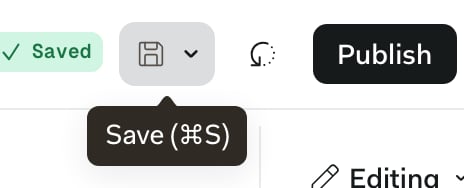 The status next to **Save** reads *Saved*, *Saving...* or *Unsaved changes*. The arrow next to **Save** also offers **Save as template**, see [From a draft](/en/features/drafting/templates#from-a-draft).
### Publish
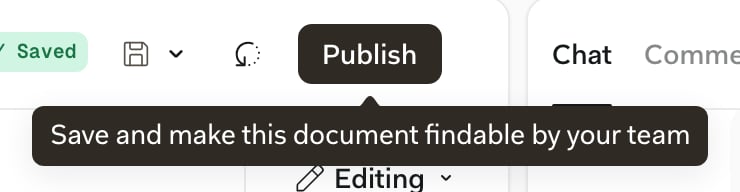
**Publish** saves and makes that version the one your team finds. It's available after the first save.
The status next to **Save** reads *Saved*, *Saving...* or *Unsaved changes*. The arrow next to **Save** also offers **Save as template**, see [From a draft](/en/features/drafting/templates#from-a-draft).
### Publish
**Publish** saves and makes that version the one your team finds. It's available after the first save.
 Who sees which version:
| Who or what | Sees |
| - | - |
| The Editor chat | What's on your screen, saved or not |
| Project members who can edit | Your latest save, published or not |
| Project members who can view | The published version |
| Search, project chat and other chats | The published version |
If Libra gives an outdated answer about a draft in another chat, publish it. Right after an upload, **Publish** waits until Libra has read the document: *Preparing this document. You can publish it once it is ready.*
Drafts you haven't published carry a tag on the Drafting page, in Project files and in the file picker:
| Tag | Means |
| - | - |
| **Not published** | Saved, but never published |
| **Unpublished changes** (*New unpublished version* on a draft card) | Published before, saved since |
| **Published** (in the Drafting page's list view) | Nothing left to publish |
### Version history
**History** in the title bar lists the saved versions: the **Current version**, numbered versions, any **Before Libra’s changes** version and the **Starting point**, which is the document before its first edit in the Editor.
Hover a version for **View**, **Restore**, **Download** and the pin that keeps it.
Who sees which version:
| Who or what | Sees |
| - | - |
| The Editor chat | What's on your screen, saved or not |
| Project members who can edit | Your latest save, published or not |
| Project members who can view | The published version |
| Search, project chat and other chats | The published version |
If Libra gives an outdated answer about a draft in another chat, publish it. Right after an upload, **Publish** waits until Libra has read the document: *Preparing this document. You can publish it once it is ready.*
Drafts you haven't published carry a tag on the Drafting page, in Project files and in the file picker:
| Tag | Means |
| - | - |
| **Not published** | Saved, but never published |
| **Unpublished changes** (*New unpublished version* on a draft card) | Published before, saved since |
| **Published** (in the Drafting page's list view) | Nothing left to publish |
### Version history
**History** in the title bar lists the saved versions: the **Current version**, numbered versions, any **Before Libra’s changes** version and the **Starting point**, which is the document before its first edit in the Editor.
Hover a version for **View**, **Restore**, **Download** and the pin that keeps it.
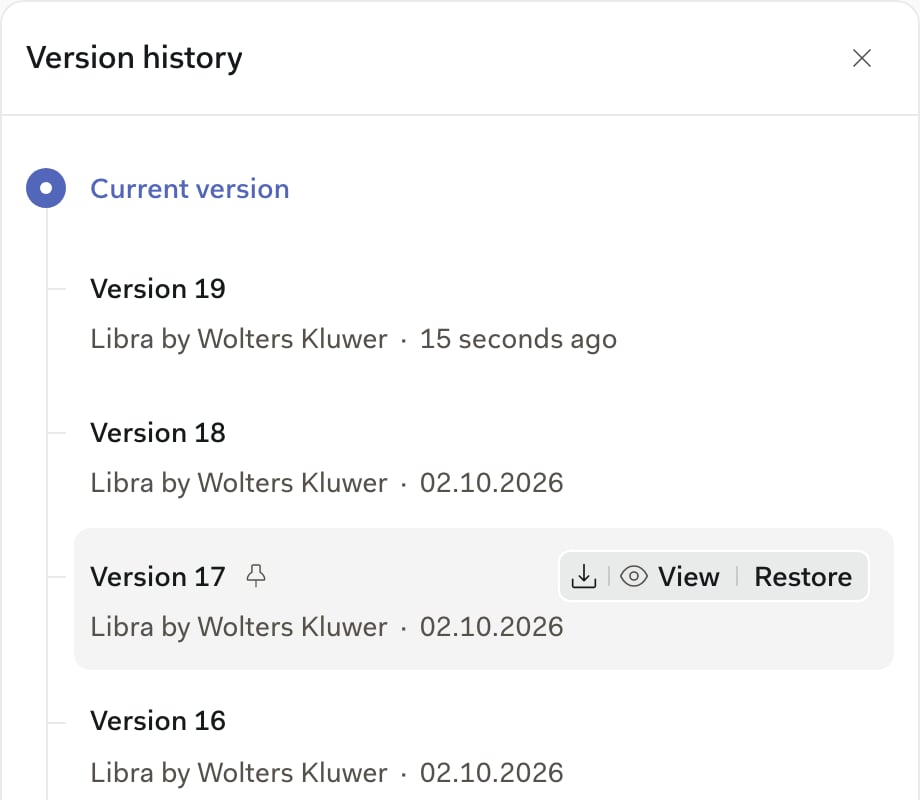 Restoring never loses anything, because your current content is kept as a version too. A restored version isn't published until you click **Publish**. The Editor keeps the newest 20 versions, plus the starting point and any version you pin.
### Download and print
Click the document's name in the title bar to open the document menu.
Restoring never loses anything, because your current content is kept as a version too. A restored version isn't published until you click **Publish**. The Editor keeps the newest 20 versions, plus the starting point and any version you pin.
### Download and print
Click the document's name in the title bar to open the document menu.
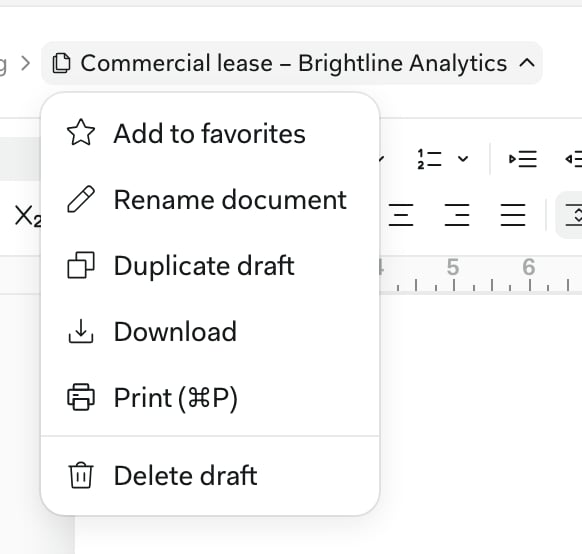 **Download** saves what's on screen as a `.docx`, and **Print** prints it. There's no PDF export; save the `.docx` as a PDF in Word. In a team, the menu also has **Share**, see [Share a draft](/en/features/drafting/collaboration#share-a-draft).
## Common use cases
The Editor chat can do your formatting too. Ask with nothing selected, since page setup applies to the whole document. Stay in **Editing** mode, since **Suggesting** refuses page setup and changes to a table's structure.
*"Number every line in the left margin, restart on each page, and set the left margin to 3 cm."* Libra switches on line numbers and sets the margin. Check them under **Page setup**, on the **Columns** and **Page** tabs.
*"Renumber the clauses with the Decimal Contract (International) preset."* Libra applies real list numbering, so the clauses renumber themselves when you add one later.
*"Put the contract into a two-column table without borders: English on the left, German on the right, one clause per row, cells aligned to the top."*
A borderless table keeps each clause next to its translation, which page columns can't, because their text flows from one column into the next. Libra builds up to 30 rows at a time, so ask for a long contract in parts.
*"A4 portrait, DIN 5008 letterhead margins, a different first page, and page numbers at the bottom right."* The different first page leaves room for your letterhead, which you add by editing the first page's header.
*"Make every Heading 2 bold, 12 pt, with 12 pt space before."* Libra redefines the style, so every heading in it changes at once. With a theme applied, change the theme instead: see [Apply and change a theme](/en/features/drafting/templates#apply-and-change-a-theme).
## Next steps
Start every draft from your firm's own documents, in your house style.
Share a draft, then work through redlines and comments.
This documentation is built and hosted on [Mintlify](https://mintlify.com), a developer documentation platform.
**Download** saves what's on screen as a `.docx`, and **Print** prints it. There's no PDF export; save the `.docx` as a PDF in Word. In a team, the menu also has **Share**, see [Share a draft](/en/features/drafting/collaboration#share-a-draft).
## Common use cases
The Editor chat can do your formatting too. Ask with nothing selected, since page setup applies to the whole document. Stay in **Editing** mode, since **Suggesting** refuses page setup and changes to a table's structure.
*"Number every line in the left margin, restart on each page, and set the left margin to 3 cm."* Libra switches on line numbers and sets the margin. Check them under **Page setup**, on the **Columns** and **Page** tabs.
*"Renumber the clauses with the Decimal Contract (International) preset."* Libra applies real list numbering, so the clauses renumber themselves when you add one later.
*"Put the contract into a two-column table without borders: English on the left, German on the right, one clause per row, cells aligned to the top."*
A borderless table keeps each clause next to its translation, which page columns can't, because their text flows from one column into the next. Libra builds up to 30 rows at a time, so ask for a long contract in parts.
*"A4 portrait, DIN 5008 letterhead margins, a different first page, and page numbers at the bottom right."* The different first page leaves room for your letterhead, which you add by editing the first page's header.
*"Make every Heading 2 bold, 12 pt, with 12 pt space before."* Libra redefines the style, so every heading in it changes at once. With a theme applied, change the theme instead: see [Apply and change a theme](/en/features/drafting/templates#apply-and-change-a-theme).
## Next steps
Start every draft from your firm's own documents, in your house style.
Share a draft, then work through redlines and comments.
This documentation is built and hosted on [Mintlify](https://mintlify.com), a developer documentation platform.