

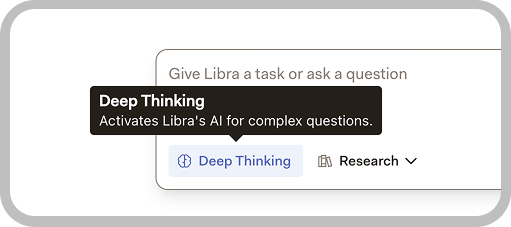

Deep Thinking is a special mode that gives Libra more time to reason through complex questions. Instead of generating an immediate response, Libra works through the problem step by step before providing an answer.
How to Activate Deep Thinking
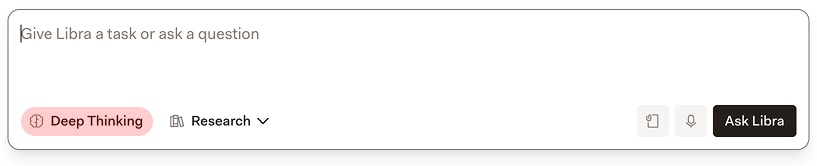
Enter your question
Enter your question as usual. Deep Thinking remains active for subsequent messages until you turn it off.
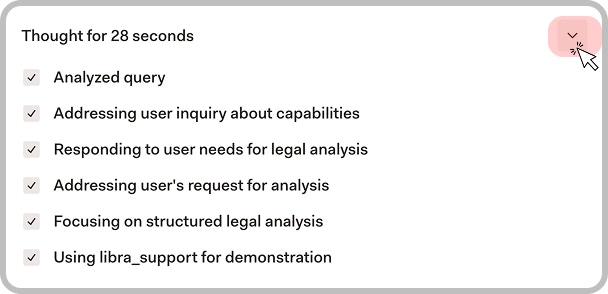
Deep Thinking responses take longer to generate - typically 30 seconds to several minutes depending on complexity. This is normal and reflects the additional reasoning being performed.
When to Use Deep Thinking
| When your question… | Example |
|---|---|
| Involves multiple steps or dependencies | Working through a multi-step legal analysis |
| Requires weighing different factors or arguments | Evaluating the strength of a legal position |
| Benefits from structured analysis | Analyzing whether a complex contract clause is enforceable |
| Includes complex instructions or conditions | Comparing several approaches to a legal problem |
| Needs careful justification or explanation | Drafting complex legal arguments with multiple considerations |
When NOT to Use Deep Thinking
Use standard mode instead for:- Simple factual questions (“What is the limitation period for contract claims?”)
- Straightforward document summaries
- Quick definitions or explanations
- Basic research queries (use Research Mode instead)
- Translation or formatting tasks
| Task | Recommended Mode |
|---|---|
| ”Summarize this contract” | Standard |
| ”Is this non-compete clause enforceable across 3 jurisdictions?” | Deep Thinking |
| ”What does § 433 BGB say?” | Standard + Research Mode |
| ”Analyze the risks in this M&A transaction” | Deep Thinking |
| ”Draft a quick email response” | Standard |
| ”Compare these two contract versions and identify key differences” | Deep Thinking |
Tips for Best Results
Provide complete context
Provide complete context
Since Deep Thinking performs more thorough analysis, it benefits from having all relevant information upfront. Include the facts, constraints, and goals in your initial question.
Be clear about what you need
Be clear about what you need
Specify whether you want an analysis, a recommendation, a comparison, or something else. Clear expectations help guide the reasoning process.
Use for important decisions
Use for important decisions
Given the additional time and cost, Deep Thinking is best reserved for questions where thorough analysis matters. For quick factual questions, standard mode is more efficient.